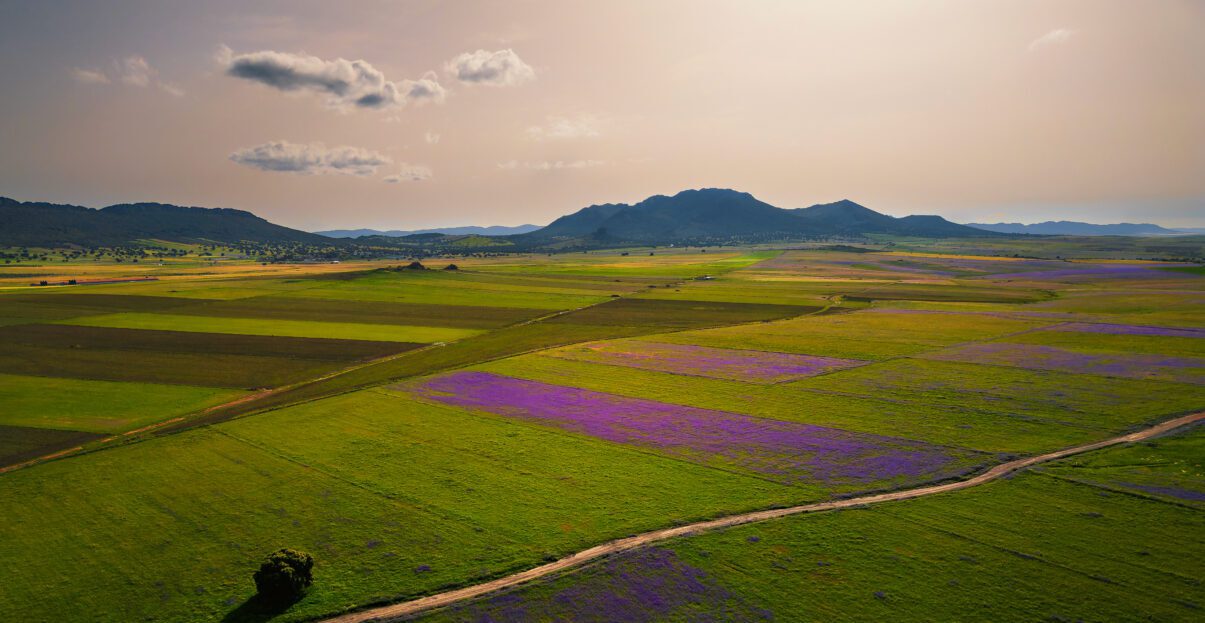
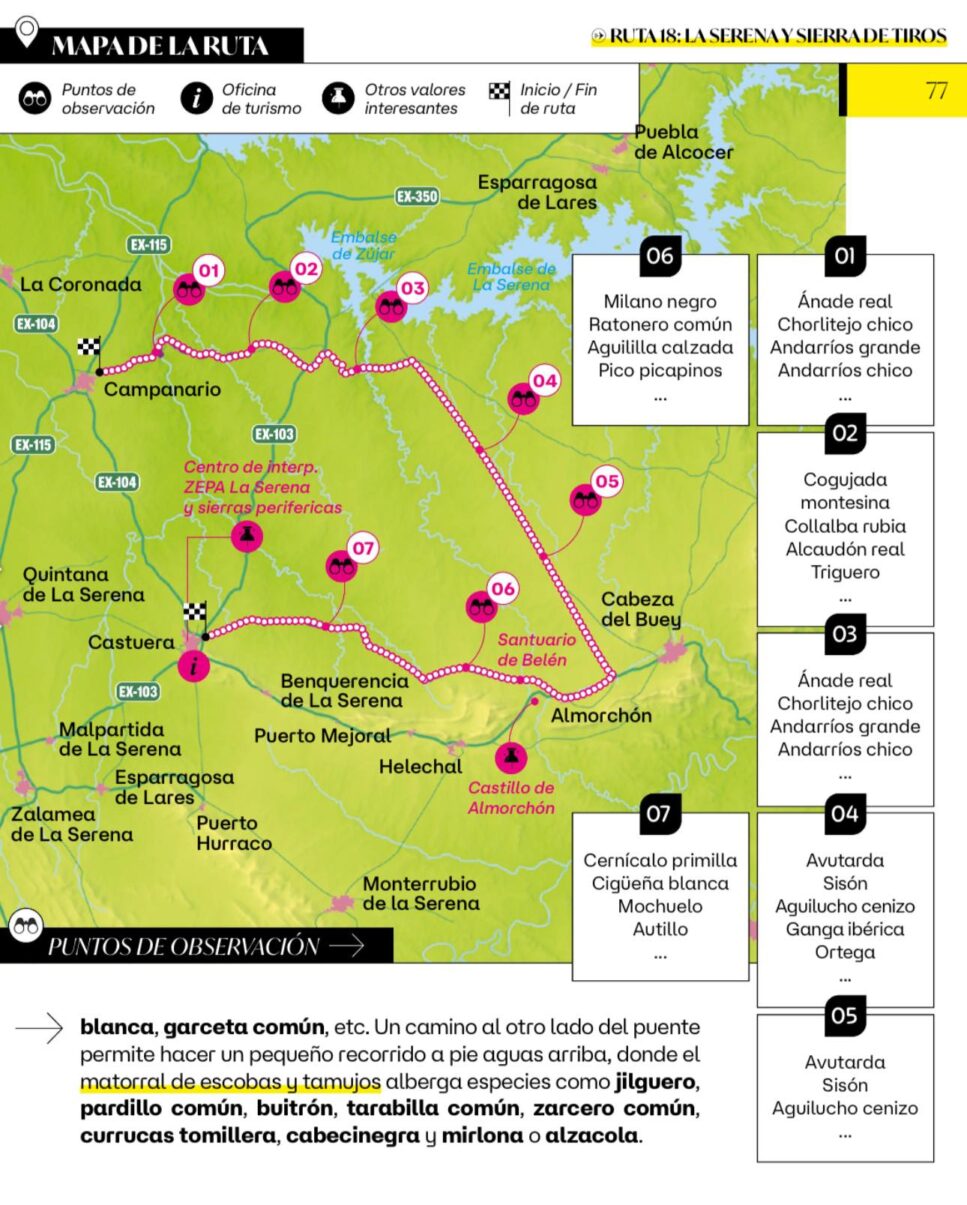
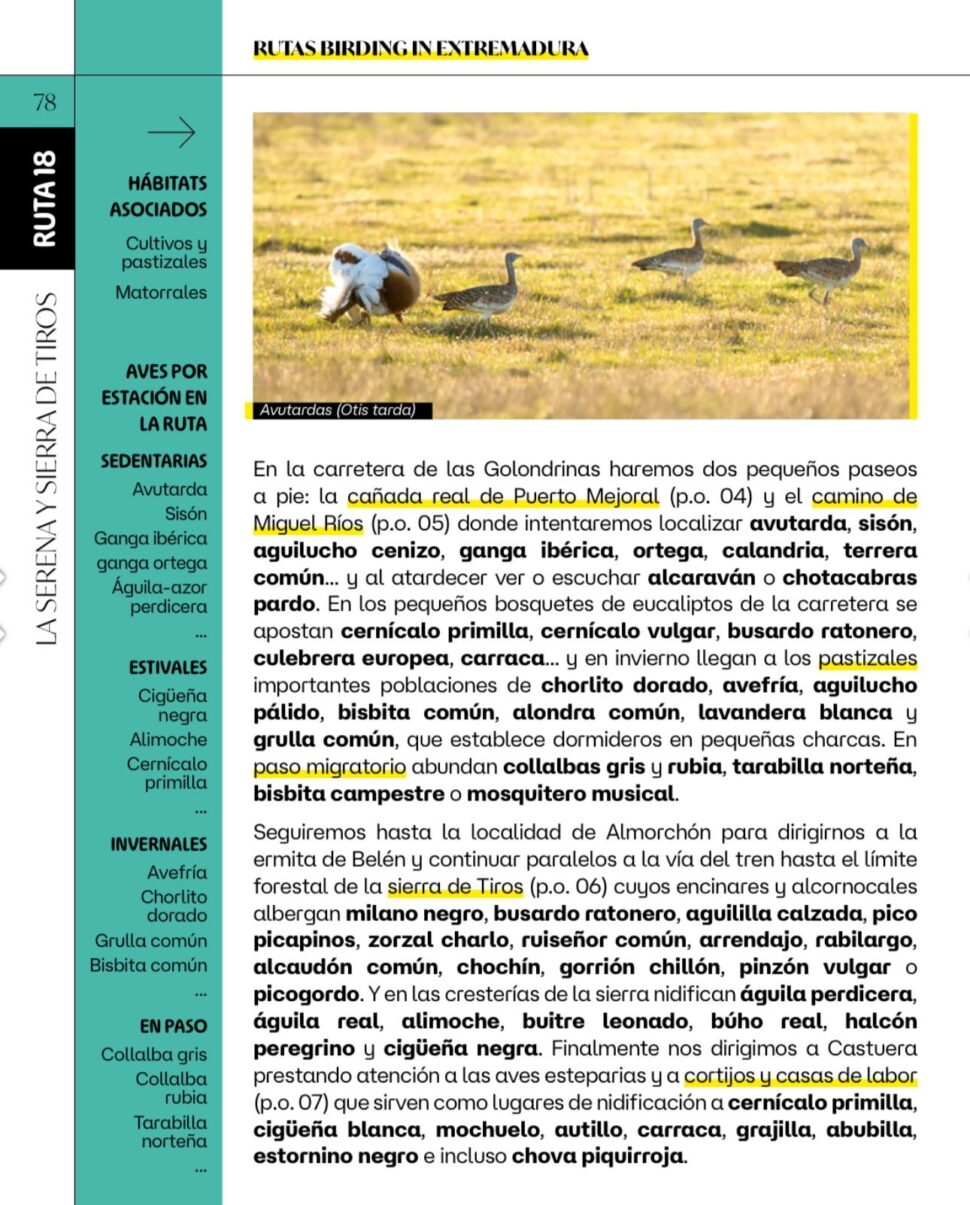
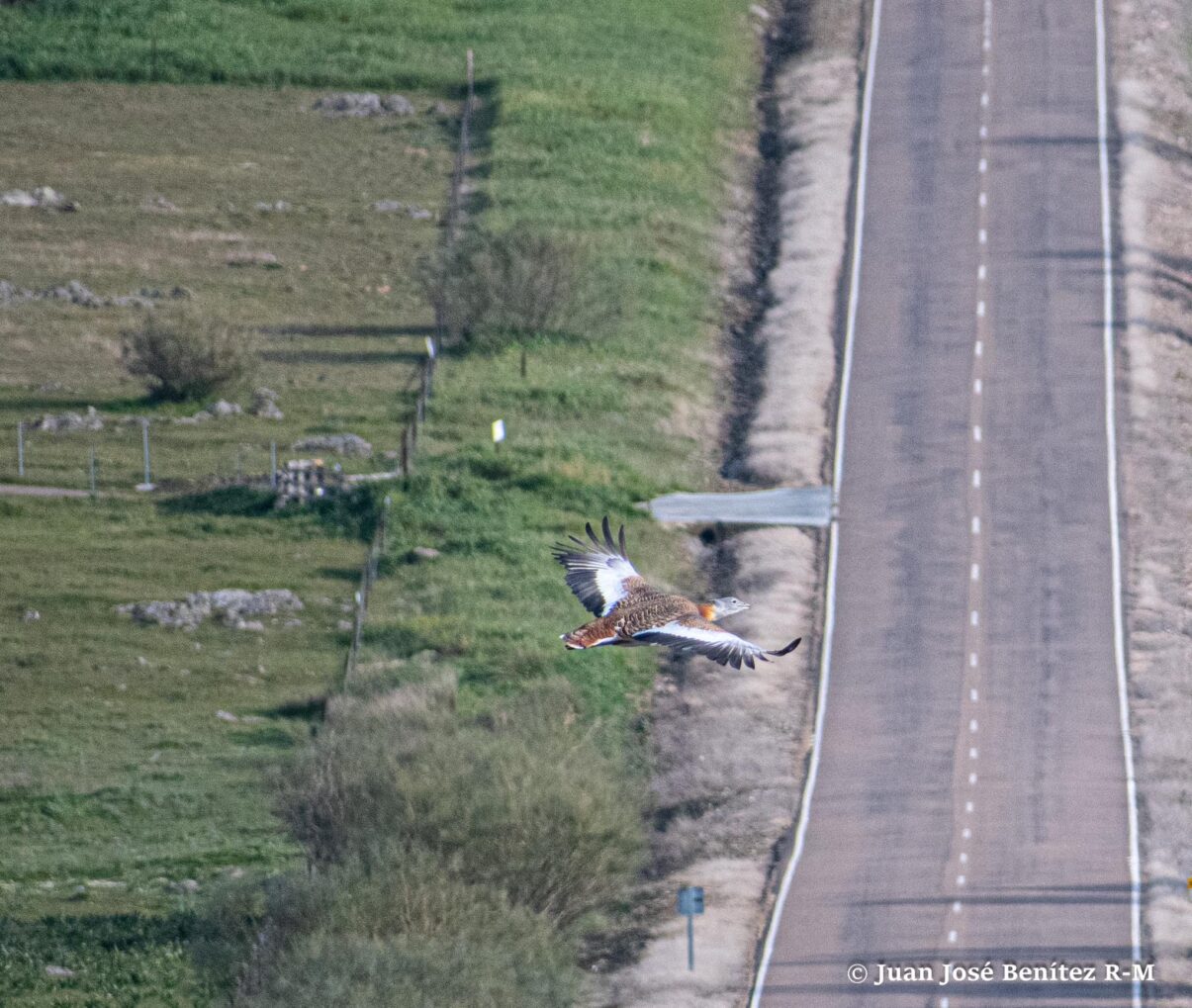
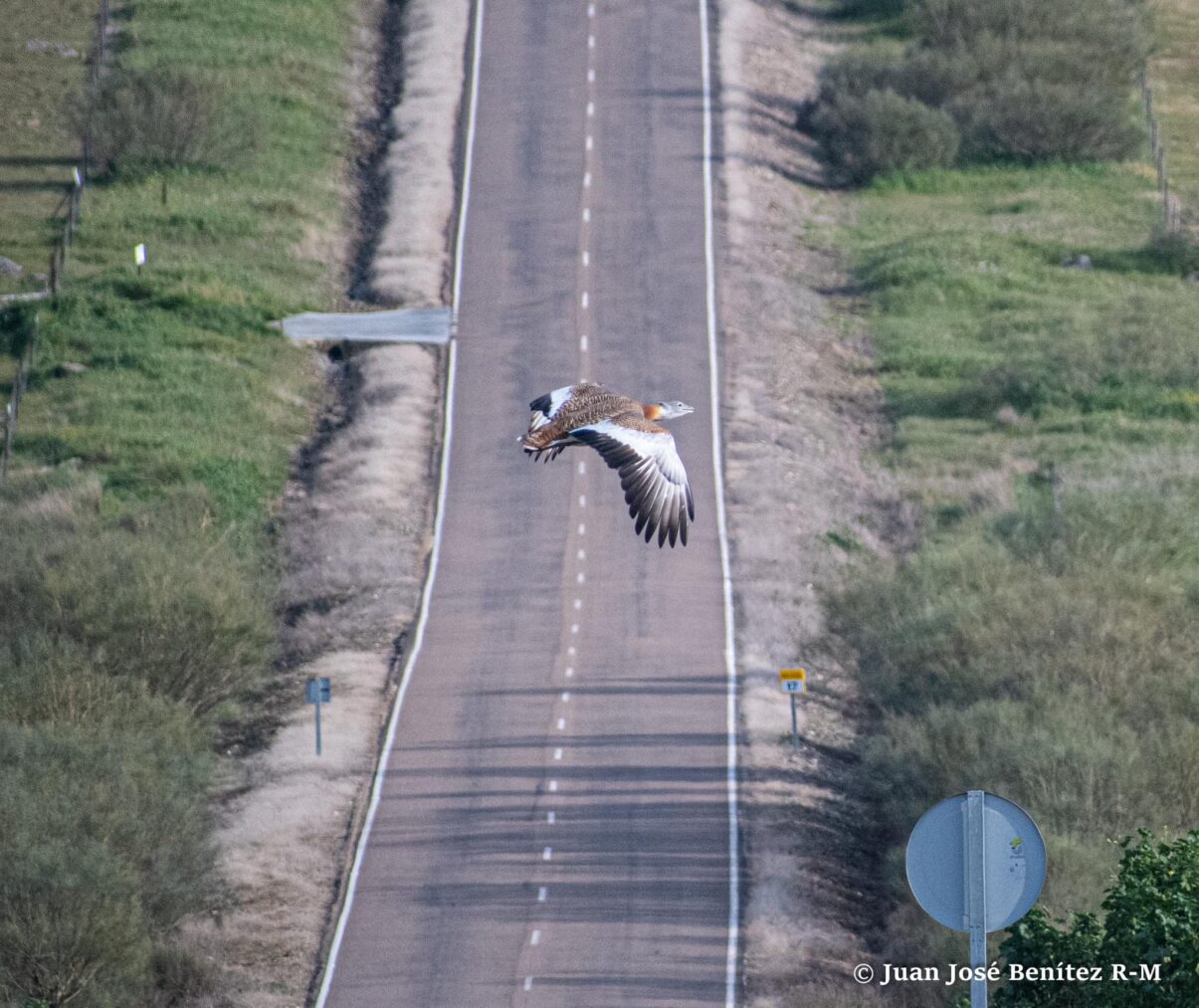
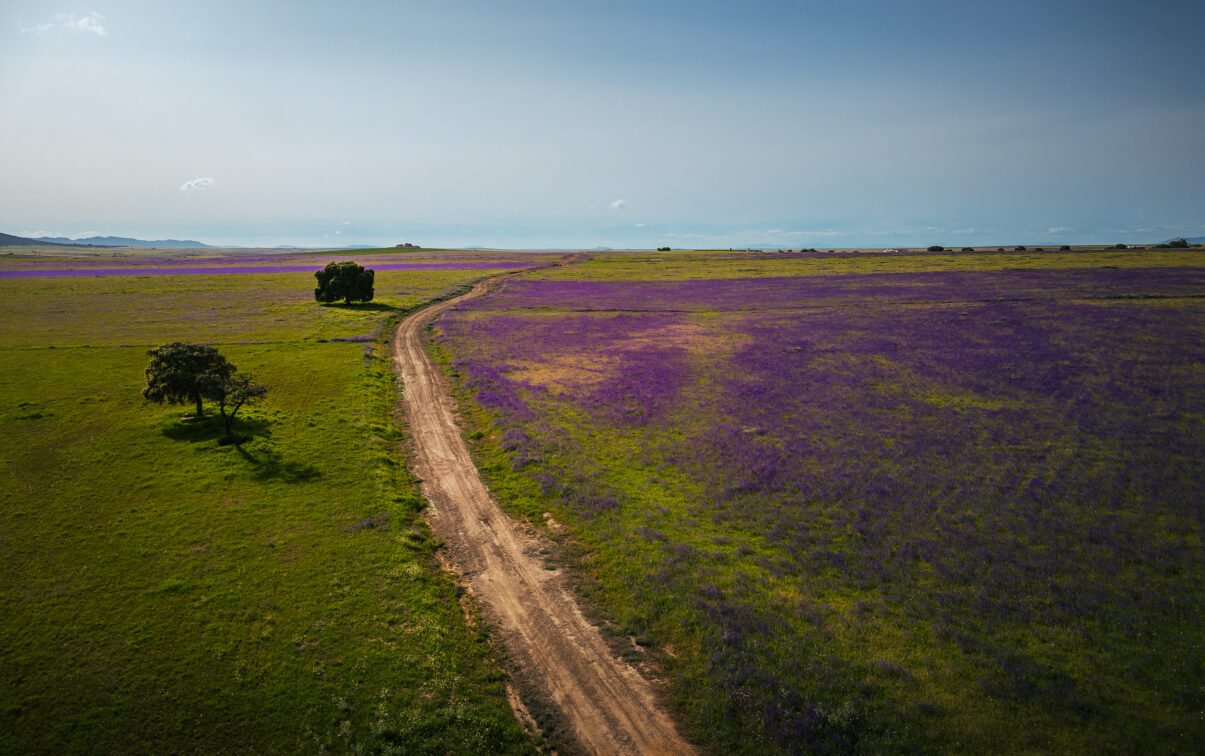
One of the best ways to observe the steppe landscapes and its rich bird life is to take a trip along the road known as “Carretera de La Golondrina”. This is the BA-035 road. This peculiar name comes from its beginnings in the sixties of the last century, when it was created as a track to access farms from the town of Cabeza del Buey, as well as to connect with the newly built reservoir of Zújar. The end of that track was at that time in the estate “La Golondrina”, and hence the name. Among the biotopes and landscapes existing in La Serena, one of the most representative is that known as the “steppe zone”, an enormous space (more than 100,000 hectares) almost completely devoid of arboreal vegetation and characterized by a peneplain used for natural pastures and to a lesser extent for agriculture, based on rain-fed cereals. Most of this area has been declared a Special Protection Area for Birds (SPA). The Golondrina road is an axis that splits the steppe in two. At the same time, from this road there is a network of public roads, in an acceptable state of conservation, which multiply the possibilities of observing the rich bird life that can be found there. In this way, either walking or making a “safari” with the car, you can make a myriad of routes through the agricultural and livestock farms of the municipality. The Golondrina road is about 24 kilometers long, running between the town of Cabeza del Buey and the Presa de La Serena, in which enormous straights predominate. It is one of the few roads that is not accompanied by electricity or telephone lines (let’s hope it continues like this forever), which allows you to enjoy a clean landscape with the same quality as always. The Carretera de la Golondrina invites to an unforgettable day of “pajareo”, which begins in Cabeza del Buey, and runs in a northerly direction. Before continuing, it is important to remember that it is not possible to park on the shoulders, and that to do so we must take advantage of side lanes and tracks, and eventually entrances, without blocking the accesses. Our safety must come first, so that we can enjoy a pleasant session in the countryside and not end in tragedy. Having said this, let’s go into some details: If we prospect the area with binoculars or a telescope, we will soon observe birds such as the Great Bustard or the Little Bustard, which are easy to spot due to their size. Sometimes they are found a little more than a hundred meters from the road. Other typical steppe species such as the Iberian Sandgrouse, the Black-bellied Sandgrouse and the Stone-curlew are much more difficult to see due to their cryptic plumage. But if we pay attention to their sounds, it is very likely that we can distinguish them in flight. Harriers are also easy to see, especially the Montagu’s harrier, but also the marsh harrier. These birds take advantage of the sowing areas to install their nests, although it is also easy to observe them in pasture areas while scanning the terrain in search of small prey. And if we visit in winter, the harrier family will be represented by the hen harrier, although the marsh harrier is still frequent. If the visit is in winter, watch out also for the short-eared owls, which can surprise us just a few meters away.
Canasteras and other smaller birds such as calandrias, cogujadas and terreras are equally frequent, although more difficult to observe due to their habits and size. Something similar happens with wheatears, pipits or stonechats. Some of the eucalyptus trees next to the road are used by booted eagles, imperial, Bonelli’s, Bonelli’s and golden eagles, Egyptian vultures, black kites and storks to build their nests. Given how vulnerable they are during the breeding season, if we make an observation it should be brief and from a distance. Many of the farmhouses that can be seen from the road have colonies of lesser kestrels on their roofs, some of them conditioned for this purpose thanks to the agri-environmental aids developed by the Junta de Extremadura, which also implements other conservation activities such as the Harrier Rescue Campaign. And although they are not steppe birds, we cannot forget the large birds of prey that frequent these peculiar spaces in search of food, especially carrion, which is certainly abundant given the enormous livestock load it hosts. It is not difficult to observe griffon and black vultures, as well as golden eagles and Bonelli’s eagles. There are different routes that can be done along the paths that start from the Golondrina road. A variant for the more adventurous is to follow the dirt track that starts at km 15.5 in an easterly direction, crossing the “Pavorosa” farm and leading to the vicinity of Zarza Capilla. Another possibility is the road opposite to the Pavorosa farm, heading west, which will take us to the mines of “Peñalobosa” and then to the Sanctuary of Belén, where in the winter months there is a passage of cranes through the Almorchón castle, considered by many ornithologists as one of the most beautiful crane passages in the world. The path of the “fina de las pozas” (to the east) and the one of Campanario (west), start from kilometer 6 of the Golondrina road, being these two very good options for birdwatching. We will surely make observations of the most representative birds of the steppe zone. Ornithological rarities are frequently observed in the municipality of Cabeza del Buey, highlighting the presence of birds from very distant places or seriously threatened as sociable lapwings, ibis eremites, Borní hawks or Bonelli’s harriers.